Six wolves ran a grizzly off a bison carcass in Yellowstone, and half the internet decided that settles the question of who’s in charge. It doesn’t. Not even close. And if you’re packing into the backcountry this April for Montana’s spring bear season — which opens the 15th — understanding what that footage actually shows, and what it doesn’t, could matter a lot more than your boot choice or your optics.
Hunters across the state are already glassing drainages from the Blackfoot to the Gallatin, from the South Fork of the Flathead to the Yaak River corridor. A lot of those drainages have something in common right now: wolves and grizzlies are moving through them at the same time, both hungry and short-tempered after a long winter. That’s not just a wildlife spectacle. It’s a dynamic you need to understand before you

What the Footage Actually Shows
The video circulating online — shot by Scott Brovsky in Yellowstone — captures six wolves from the 8 Mile pack harassing a grizzly off a bison carcass. They nipped at its flanks, kept the pressure on, and the bear eventually retreated. It’s real, and it’s dramatic. But here’s where the online commentary goes sideways: people watch that clip and conclude wolves dominate grizzlies. That’s not what the science says, and it’s not what experienced Montana hunters and outfitters have observed across decades in the field.
What that footage actually shows is a numbers and context game, not a definitive predator hierarchy. One grizzly against six coordinated wolves on an open flat, over a carcass the pack almost certainly found first — that’s a scenario where harassment tactics work. Change any one of those variables — reduce the pack, tighten the terrain, or give the grizzly a cub to defend — and the outcome flips hard.
What Science Says About the Real Hierarchy
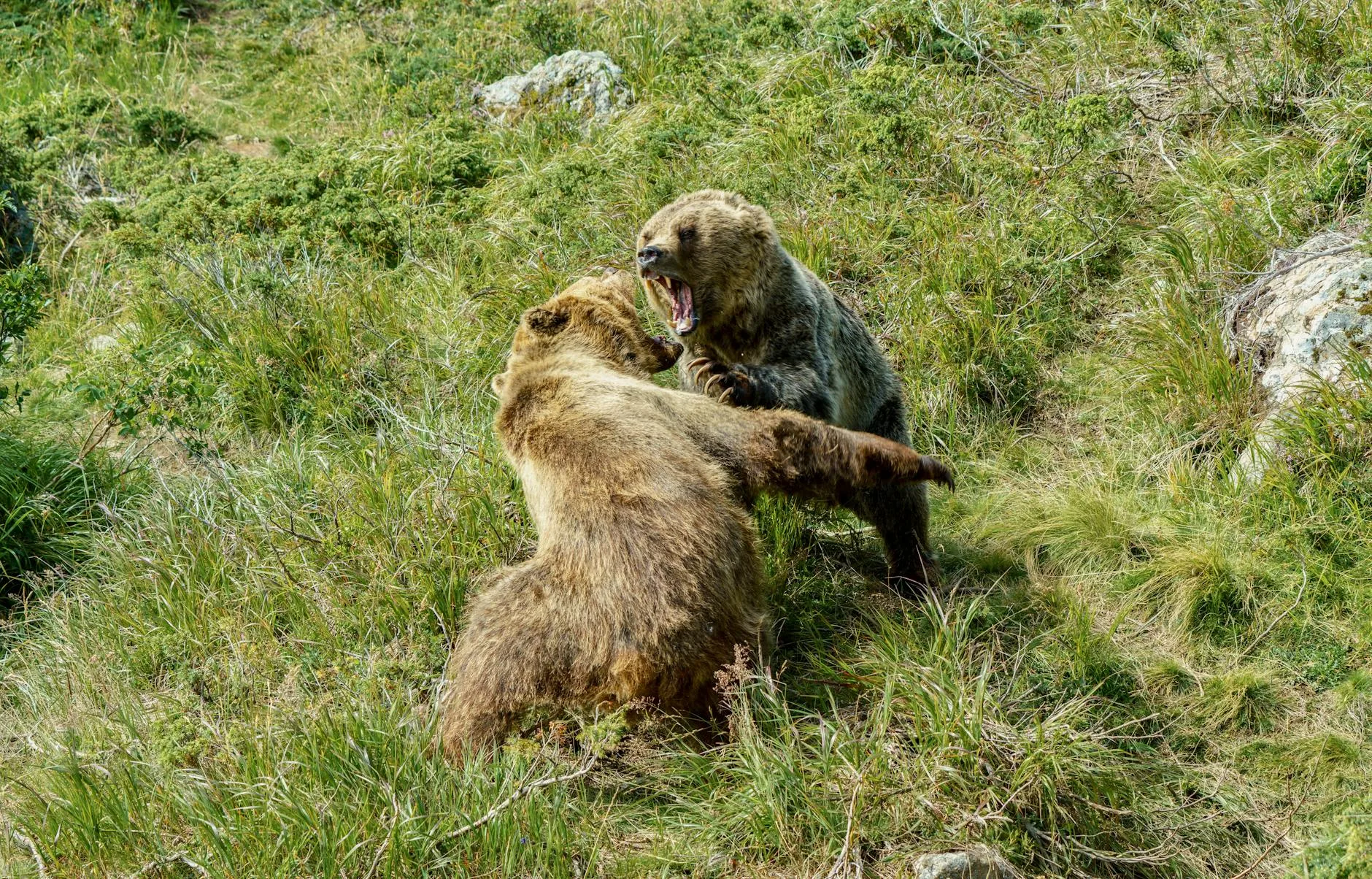
Research out of Yellowstone, where wolf-grizzly interactions have been studied more carefully than anywhere else in the lower 48, tells a more nuanced story. Grizzlies are kleptoparasites by nature — they steal kills from wolves far more often than wolves push them off. A 2012 study published in PLoS ONE found that grizzlies usurped wolf kills regularly in Yellowstone, particularly during spring when bears come out of dens calorie-starved and looking for a fight. Single adult male grizzlies, especially, send wolves scattering more often than not.
Pack size matters enormously. Six wolves operating in tight coordination is a completely different equation than a two or three-wolf group trying to hold a carcass. Wolves are also smart enough to pick their battles. Trail cam footage from the Rocky Mountain Front and the Swan Range consistently shows wolves giving solo adult grizzlies a wide berth unless there’s something worth fighting over. A dispersing lone wolf that bumps into a boar grizzly on a spring hillside? That wolf is moving on. Honestly, I think a lot of people underestimate how often grizzlies are the ones doing the displacing out here — we just don’t have camera crews around to film it.
Where These Animals Are Overlapping in Montana Right Now
The overlap zones that matter most to spring bear hunters are well-established and still expanding. The Northern Continental Divide Ecosystem — the drainages around Hungry Horse Reservoir, the Middle Fork of the Flathead, everything flowing into the Bob Marshall Wilderness — holds some of the densest grizzly populations in the lower 48. Wolf packs like the Spotted Bear Pack and others working the South Fork drainage are active in the same country, often the same drainages, sometimes the same week.
Over in southwestern Montana, the Madison Range, the Gravelly Mountains south of Ennis, and the upper Ruby River drainage are seeing real grizzly presence now as the population pushes south and east out of the Greater Yellowstone Ecosystem. Multiple wolf packs work those same drainages. If you’re hunting bear in those units this April, you’re hunting wolf country too — whether you see them or not.
What This Means for Hunters in the Field
Understanding wolf-grizzly dynamics isn’t just intellectually interesting this spring — it has real safety and strategic implications for anyone spending time in these drainages.
- Fresh wolf kills attract grizzlies fast. If you locate a wolf kill — gut pile, cached carcass, bone scatter — treat that site like grizzly country regardless of what your mapping app says about habitat. Bears key in on these sites within hours, especially in April when vegetation hasn’t greened up and natural forage is scarce.
- Wolf vocalization near a carcass is a signal, not just ambiance. If you’re sitting near bait or a gut pile in wolf country and you hear a pack working nearby, your bear attractant just became a grizzly attractant too. Plan accordingly.
Grizzly encounters spike hard in April. Bears are out of the den, hungry, and covering ground fast. Low natural food availability combined with winter-killed ungulates — plus whatever gut pile you left — creates real congregation risk in drainages like Spotted Bear River, Danaher Creek, and the Gallatin Canyon south of Big Sky. Keep bear spray on your hip, not buried in your pack. A grizzly moving in to displace wolves from a kill site doesn’t give you time to dig for it. Check FWP’s grizzly distribution maps before you go, too — Montana Fish, Wildlife & Parks updates them regularly, and the 2025 data on expanded grizzly range into the Gravellys and the Madisons should absolutely be part of your pre-hunt research.
So Who Actually Wins?
Six wolves can run a grizzly off a carcass. A big boar grizzly can scatter an entire pack when it decides something’s worth taking. The real answer is it depends — on pack size, individual bear size, terrain, food pressure, and whether there are cubs in the picture. Neither animal is universally dominant, and both are sharing more Montana ground every April.
In my experience, the hunters who get into trouble in this kind of country aren’t the ones who fear these animals — they’re the ones who’ve simplified them. Don’t simplify them. Go in knowing the drainages you’re hunting, knowing what’s been active, and knowing that the same carcass that pulled you in off the ridge may have pulled something else in first.